Fort Adams, Engineering Report, July, 1863 (#071512)Lt. Gen. U. S. Grant;
CommanderAll Union ArmiesBrig. Gen. M. BurbankCommanderNew England BrigadeD. Erickson, MajorCommandant (Acting)U. S. Corps of Topographical EngineersMost Honored Sirs;I beg your indulgence to receive the Engineering Report from the Fort Adams Event on the subject dates.In Attendance:-- Ian McKay, Brig. Gen. of Engineers (By Brevet);-- Major James Duarte (Adjutant, Senior Field Engineer)-- First Lt. Greg Webster (Ordnance Expert, Field Engineer)-- Lady Heidi Webster, (Field Artist);-- Lady M. Mathews, (Paymaster, Teamster).Lady Mathews and I arrived at Fort Adams to find our previous registrations in order, and we moved smoothly through the gates into the fort interior. A this point, I must document my thanks to Mr. Robert McCormack, Fort Adams Director of Services for his very kind invitation to provide an Engineering Display in the North Casemates, and to reserve a section of the casemates for such a display. This invitation turned a normal reenactment event for the Topog. Engineers into the specialist event for the year.On our arrival we began the set-up of the Engineering Display, and immediately delivered three sets of four maps and map notes relating to Fort Adams and vicinity to the Brigade Staff. Later in the afternoon, Lady Webster and Lt. Webster arrived with two more maps of the area which were also immediately transmitted to the Brigade Staff. Lt and Lady Webster had made arrangement to stay in the casemates during the event while Lady Mathews, Major Duarte and I responded to an invitation from the town to take advantage of an offered lodging and found in Newport. A brief discussion with the Brigade Commander determined that the area just outside of the fort should be looked at, n the following morning, in case of any Confederate attacks directed against the fort.On Saturday Morning we arrived back at the fort and I immediately ordered both Major Duarte and Lt. Webster to make patrol surveys of the fort perimeter, and from those surveys draws sketch maps to be provided for the Brigade Commander's use in evaluating the area for a possible meeting of Confederate Forces. During this period, I busied myself in working with calculations in determining the width of a river for the purpose of erecting a bridge for a crossing. Lady Webster, was kept busy through the morning answering questions from visitors about the display. From time to time I was called upon to answer a particular question and the morning passed by quickly. Wellas before noon both field engineers returned with the Patrol Surveys, and busied themselves with producing the requesting sketch maps of the area for the Brigade Commander. Those maps and reports were immediately delivered to the Brigade Staff as soon as completed. Later just prior to the planned skirmish, the Brigade Commander came to me and explained in detail his battle plan for the projected attack. I was honored to be asked to narrate to a portion of the crowd, the action on the field as well as some of the lesser know military details that might prove to be confusing to our spectators.During the skirmish Lt Webster was on the field to insure that all the information relating to the battle needed by the engineers was collected and preserved. I was asked many, many, questions in regard to the skirmish going on and then stayed for abut a half hour after the skirmish answering questions from all. I was also pleased to receive from many spectators their congratulations and enjoyment dealing with the skirmish. From the skirmish field we retired back to the engineering display area, answering questions from spectators / visitors. I was pleased to have a brief discussion with the Brigade Commander and other staff in regard to the skirmish and we discussed many of the points brought forward by the field commanders, what could be improved and what was done well. Lady Mathews came at about that time to retire into town once again.On Sunday Morning, we arrived back at the fort at about 8:00 A.M. and I began the day working out the detailed aspects of a standard "ditch and parapet" outline with distances and angles to be used when these field fortifications will be needed. In the late morning the Brigade Commander discussed with me his battle plan to meet the Confederates should they begin the attack once more. I was again honored to be asked to narrate to the visitors what was occurring on the battle field. Shortly, the troops began to assemble and Major Duarte very generously assisted me to the skirmish field again as he did on Saturday. The skirmish was delayed for a short time and began with a heavy exchange of artillery fire. The skirmish progressed to its conclusion and again I was asked many, .many, questions about the military on the field, and met some people who were also very interested in the Civil War. After the battle, we began the long job of packing all the weapons, models, torpedos (bombs), tools, and instrumentation for the long trip back home. This effort took about an hour with the help of Lady and Lt. Webster as well as Major Duarte.Lt. Gen. U. S. Grant:-- I beg your attention to both Lady and Lt. Webster. Their efforts through this special Engineering Display, from their added and most significant display f "infernal devices," to their detailed and consistent help with all of our visitors / spectators, was most impressive. Lady Webster also offered her assistance on the field as a lady participant, and Lt. Webster's determination to capture every aspect of the two skirmishes that would be valuable information to consider in the future.Excused on sick leave were:Major R. Germain and Lady Germain;Excused on detachment were:Lt. General Grant and Lady Grant;Captain Wayne Lafleur;Captain N. Reicke;Second Lt. John Proctor;Corporal M. Grossman.Your Most Admiring and Diligent Servant;Very Respectfully;Ian McKay, Brig. Gen. of Engineers (by brevet)Chief Engineer and Chief of Staff (acting);Lt. Gen. U. S. Grant's Personal and Military StaffsandCdr. -- NETE__._,_.___.
__,_._,___
Friday, August 3, 2012
Fort Adams Engineering Report, July, 2012


Thursday, August 2, 2012
20 In Muzzle -Loading Cannon


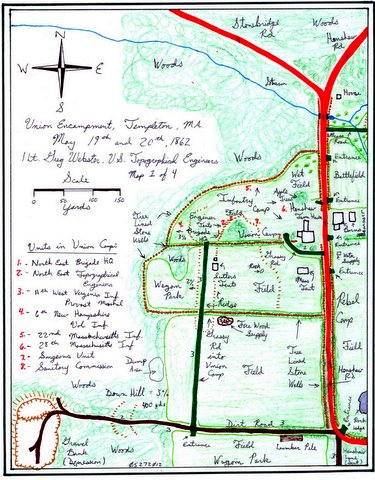
Map of the Union Encampment, Templeton, MA, May 19-20, 2012

Wednesday, August 1, 2012
Engineer's Report -- Chase Farm. Lincoln, RI, September 2011
Lt. General U. S. Grant,
Commander,
All Federal Forces
Brig. General M. Burbank,
Commander,
New England Brigade
Major D. Erickson,
Commandant (acting),
U. S. Corps of Topographical Engineers
Honored Gentlemen,
I beg your most kind indulgences to make my activity report.
Topographical Engineers present at the reenactment:\
--Ian Mckay, Brigadier General of Engineers (by brevet)
; --Captain Ray Germain;
--Captain Norbert Reicke (seconded to the 9th Mass. Art.);
--Lt. Greg Webster (seconded to the 9th Mass Art.);
--Corporal M. Grossman, (Pioneers, 25th Inf.);
--Lady Heidi Webster (seconded to the 9th Mass Art.);
--Lady Maryanne Germain (Civ. Artist);
--Lady M. Mathews (Purser and Teamster).
Upon orders sent to General McKay, from the U. S. Grant Headquarters, I departed the New London area in the fast dispatch schooner moored at Fort Trumbull, New London, CT. We reached the city of Providence, R. I. in good time and from there took a carriage to Lincoln, R. I. and from there on to the Chase Farm, arriving in the early afternoon. I found Captain Germain already there and set up. Together we set up the Engineering Field Office. .
General Burbank came over to discuss the fortifications planned for the battlefield. He generously took me to the site and explained what he wanted to do with the materials which were available. Upon return to camp, I designated Captain Germain to supervise the construction to the gun emplacements and the field fortifications.
Corporal Grossman arrived at the field office and I gave him his drawing packet.
Lady Mathews departed to make arrangements with the family who had offered us refuge for the nights. When she returned, the Germains, Lady Mathews and myself enjoyed a sumptuous supper at a small Inn at the top of Breakneck Hill near the farm.
On Saturday morning a work party of about 60 men was gathered to build the fortifications and gun emplacements. Corporal Grossman came by to pick up some tools for the work ahead. I designated Captain Germain to make a copy of the battlefield and fortifications for the unit files. Lady Germain was asked to draw the Confederate Camp on the far hill. I busied myself in constructing a model of a corduroy road from downed limbs under the trees near to the field office.
I was relieved of the task of battle narration because a professional speaker had been appointed by the Chase Farm to undertake those tasks.
When the fortifications were finished, Corporal Grossman returned the borrowed tools, and Captain Germain showed me his rough sketch of fortifications for approval. I approved the rough drawing. Captain Germain and I spent most of the rest of the day; he finishing his drawing, and I working on the model.
Lady Mathews returned in the early evening and the Germains, Lady Mathews and I retired to the inn on the hill for a second sumptuous dinner, then back to the house in Lincoln.
Sunday morning we were back in camp by 8:00 A.M. and began working on the model again. On Saturday and Sunday, Captain Germain and I spent a good deal of time meeting and greeting the various spectators, answering their questions and telling them about the engineers, who they were, what their purpose was, and discussing the displays provided. Of all the displays , the caltrops were by far the most questioned item.
Lt. Webster and Lady Webster came over to the Field Office and spent some time there during a lull in the artillery drill / practice.
By midday the model of the corduroy road was finished and I had explained the use of that construction to several spectators.
After Sunday's skirmish the word was given to break camp, and the next hour was spent in packing the wagons. The Germains, Lady Mathews and I enjoyed a late afternoon meal at the Inn on the hill and made our way back to New London as we had come. The weather was splendid over the weekend, if somewhat cool in the mornings. The Union HQ camp was on the edge of the bluff above the Chase Farm and the battlefield was marked out between the rising hill to the right and the great pond to the left. The Union camp was laid out along the access road to the far right of the upper fields. Between the Union camp and the battlefield was a rising mound which afforded a good view of the battlefield for the spectators.
Respectfully Submitted;
Your Most Admiring and Diligent Servant,
Ian McKay, Brigadier General of Engineers (by brevet);
Chief of Staff (acting) Chief Engineer,
25th Corps
Lt. Gen. U. S. Grant's personal and military staffs ,
And
Cdr. -- N.E. Topog Engineers (NETE)
Subscribe to:
Posts (Atom)